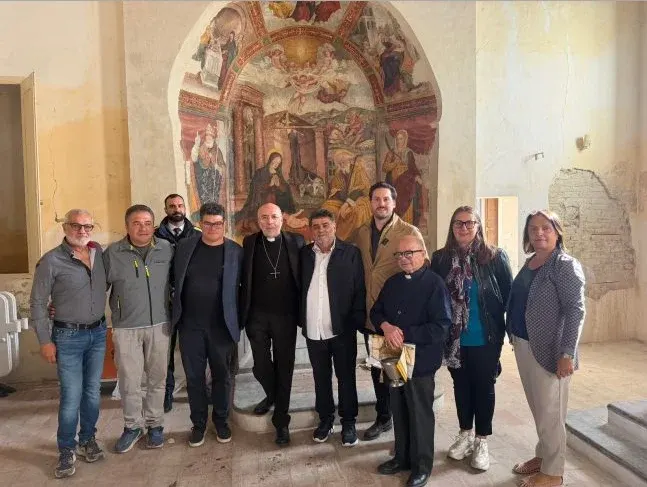
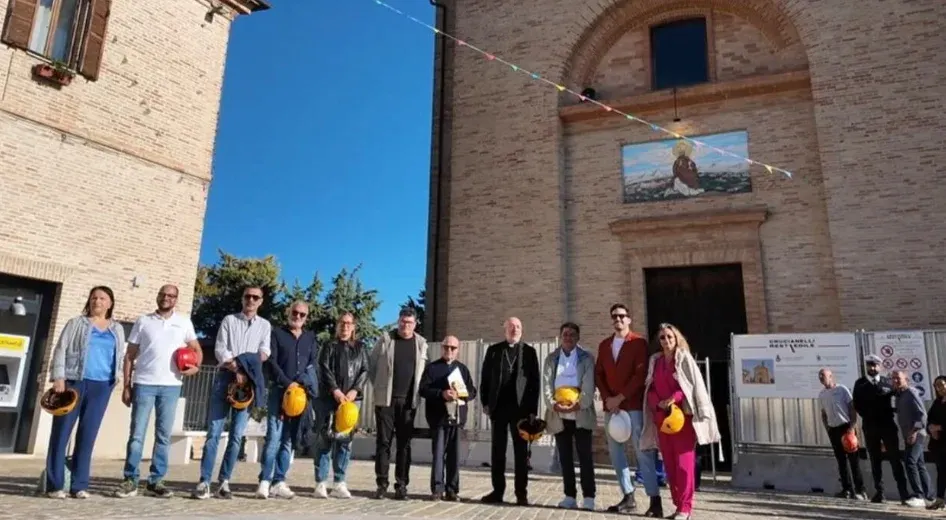
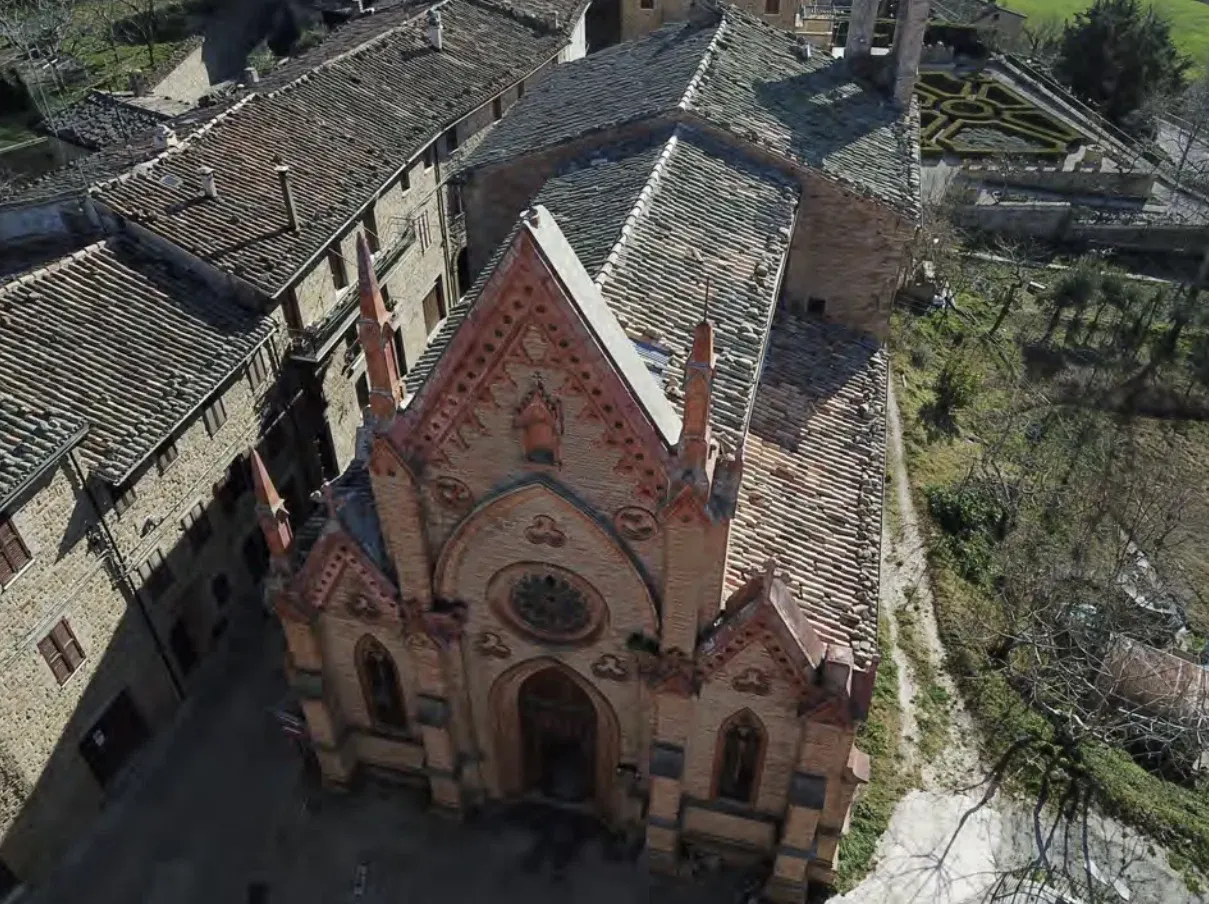
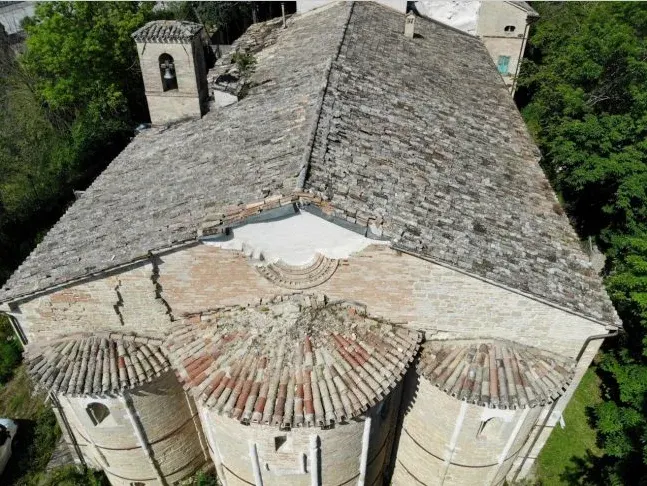
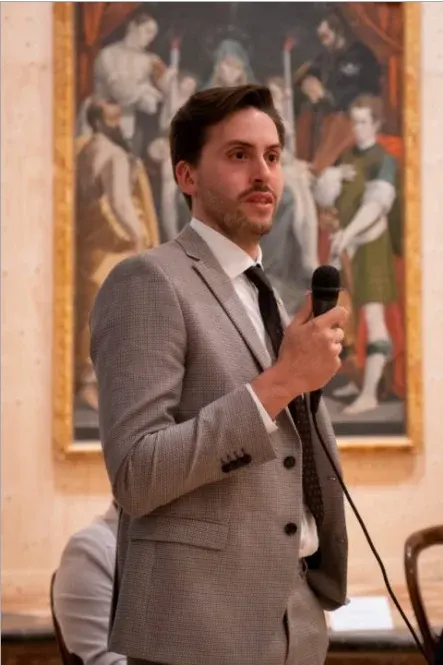
Work is getting underway on three churches in Colmurano: Santissima Annunziata, Buona Morte, and San Donato. The projects involve repairing structural damage caused by the 2016 earthquake. The interventions were designed by engineer Enrico Mariotti and architect Matteo Sampaolesi. All three projects are funded under Ordinance 105 of 2020, issued by the Commissioner's office. Bishop Nazzareno Marconi blessed the start of the work, wishing the technicians and laborers at the San Donato church a successful project this morning. Mayor Mirko Mari and parish priest Father Eugenio Tordini were also in attendance.
On the liturgical feast of Saint Vincent Maria Strambi, co-patron of the Diocese of Macerata, Bishop Nazzareno Marconi presided over the blessing ceremony marking the start of construction work at the churches of Santissima Annunziata and Buona Morte in Colmurano. Restoration work has also begun on the church of San Donato. The Bishop commended the technicians, the workers, and the successful outcome of the project to the Lord, and asked the parish community to support the work through prayer.
We are returning to the community another architectural, historical, and religious gem that is part of our tradition,” emphasizes Guido Castelli, the Commissioner for the 2016 Earthquake Reconstruction. “I thank Regional President Francesco Acquaroli, Archbishop Francesco Massara, the Reconstruction Office, and Mayor Giuliano Ciabocco for their excellent and consistently productive collaboration.
The restoration project continues; Nazzareno Marconi, Bishop of Macerata, states: "We have synthesized the various inputs received from the local community with the diverse needs—liturgical, pastoral, and cultural—firm in the conviction that only a unified, long-term vision can restore this site to the role it deserves."
The design team, coordinated by Professor Mauro Saracco, has carried out a geometric survey of the entire Santa Maria di Rambona Abbey complex in Pollenza—comprising the crypt, the villa, and the former Carolingian hall—while liaising with the three relevant owning entities: the diocese, the Santa Maria Assunta parish, and the Diocesan Institute for Clergy Sustenance. The diocese itself announced this update, providing a status report on the restoration work.
The design process is being handled as a unified whole, even though these major components will rely on different funding channels (involving both private and public reconstruction efforts), the statement continues. New preliminary assessments—geological, geotechnical, and seismic—have been conducted as authorized by the Superintendency, alongside structural tests and stratigraphic analyses by the restoration specialist; existing data from previous studies have also been retrieved and reviewed.
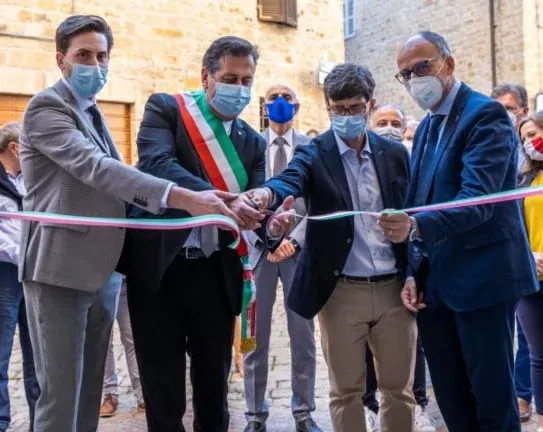
Ribbon-cutting ceremony for the exhibition curated by Matteo Sampaolesi, marking the village's cultural rebirth. Unicam Rector Claudio Pettinari was also in attendance.
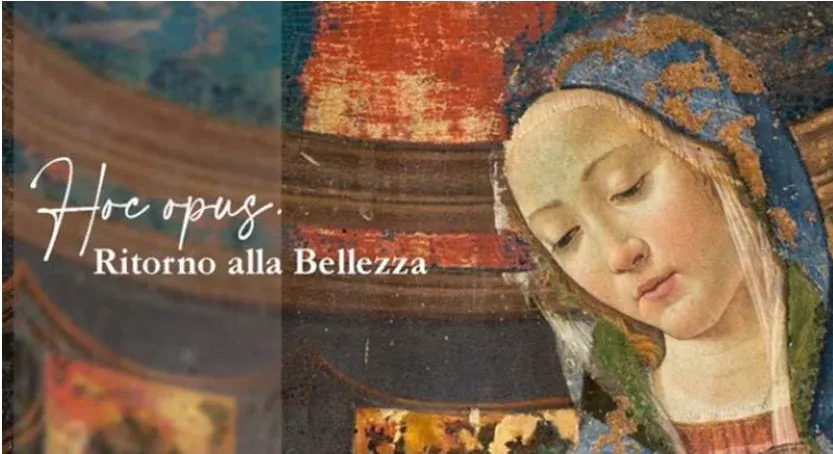
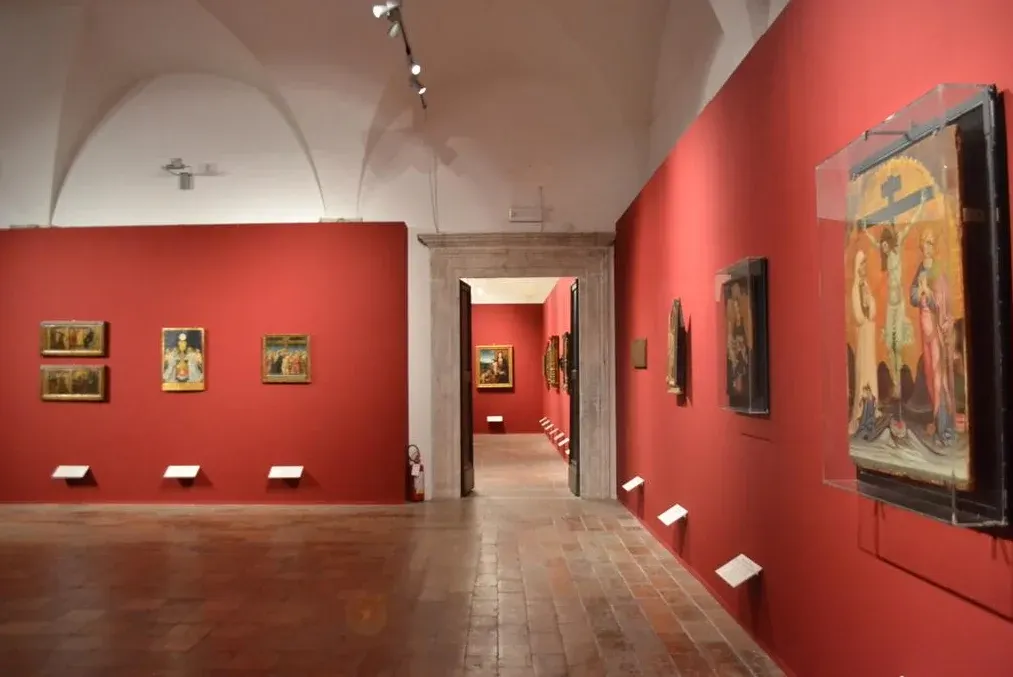
The doors of the Sant'Agostino Auditorium have finally reopened with the inauguration of the exhibition "Hoc Opus. Ritorno alla bellezza" (Hoc Opus: A Return to Beauty) in San Ginesio, promoted by the Municipality under the patronage of the Marche Region and ICOM (International Council of Museums Italy). A great many people turned out for this extraordinary occasion—marking a first yet fundamental step in the village's cultural rebirth—even though many had to wait outside for their turn due to current COVID-19 safety regulations. The ceremony was imbued with a solemn atmosphere, enhanced by the elegant display setup featuring light burl-wood panels that further accentuated the grandeur and beauty of the artworks. Visitors gazed happily at the pieces they had missed for so long, pausing before the famous *Altarpiece of Saint Andrew* and the painting depicting the battle between the people of San Ginesio and Fermo—created around 1463 by Nicola di Ulisse da Siena—which was returned to its original location (the second altar on the left side of the nave) for this exhibition. A special section in the Auditorium’s sacristy was also dedicated to the 16th-century San Ginesio painter Domenico Malpiedi; often unfairly dismissed with the usual prejudice against so-called "provincial" art, he deserves a comprehensive study that re-evaluates his artistic training. Mayor Giuliano Ciabocco opened the ceremony with a voice thick with emotion, highlighting the significance of the moment for the entire region, which had been deprived of its cultural treasures following the tragic 2016 earthquake. The mayor also emphasized the remarkable nature of the project—completed in record time—which enabled both the reopening of the Auditorium following safety reinforcements and the return of the artworks to their home.Sincere thanks were extended to the exhibition’s curator and organizer, architect Matteo Sampaolesi—a native of San Ginesio. Grateful for the trust placed in him, he explained his design concept to the assembled guests, describing it as "conceived as a parasitic architecture that provides structural stability while generating new spaces and perspectives within the existing structure. The use of humble wood is an intentional reference to the ephemeral nature of things and the suspended sense of time we are currently experiencing."
Speeches followed from Unicam Rector Claudio Pettinari and the President of the Sibillini Mountains National Park, Andrea Spaterna; both reaffirmed their support for San Ginesio, highlighting its strategic importance—culturally, educationally, and for tourism—as the gateway to the National Park. Engineer Paolo Iannelli, Special Superintendent for the areas affected by the earthquake of August 24, 2016, also spoke, praising the municipality’s initiative for successfully combining the building's structural stabilization with an exhibition of immense scale and extraordinary appeal to tourists.
Finally, Giordano Saltari, the Councilor for Reconstruction, expressed his gratitude to the companies, staff, and collaborators who worked tirelessly on this cultural revitalization project. The joyful event concluded with a beautiful performance by the Corale Bonagiunta choir from San Ginesio, who sang famous arias by Giuseppe Verdi and paid a special tribute to Maestro Ennio Morricone with the immortal notes of the *Once Upon a Time in America* soundtrack.
The doors of the Sant’Agostino Auditorium have reopened with the inauguration of an exhibition curated by Matteo Sampaolesi. The venue has finally opened its doors again—following safety upgrades and the return of the artworks—to host the exhibition "Hoc Opus: Return to Beauty," promoted by the Municipality under the patronage of the Region and ICOM (International Council of Museums Italy). Starting Saturday, residents and visitors can once again admire these long-absent treasures and view the famous *Saint Andrew* altarpiece, as well as the painting depicting the battle between the people of Ginesio and Fermo—created around 1463 by Nicola di Ulisse da Siena—which has been returned to its original location for this exhibition.
Every journey comes to an end, and after four years—with the 6:00 PM opening on Saturday, July 18, of the exhibition “Hoc Opus. Ritorno alla Bellezza” (Hoc Opus: Return to Beauty), hosted at the Sant’Agostino Auditorium in San Ginesio—the precious paintings that once filled the San Ginesio Pinacoteca Antica before the earthquake will finally return to their home territory.All the other works that will finally be brought back to light date from the 17th and 18th centuries. Two high-quality canvases—derived from the styles of Battistello Caracciolo and Carlo Maratti, respectively—represent the *Visitation* (a gift to the Pinacoteca from the Counts Onofri family) and the *Assumption of the Virgin among Angels* (on loan from the Church of Santa Maria in Vepretis, belonging to the Caracciolini Fathers). Other paintings, too, can be seen as a natural continuation of Maratti’s influence, aligning with the moderate character of the Marche region’s visual culture—which favored that balanced reconciliation of Classicism and Baroque, of the antique and the modern, so highly prized by patrons.
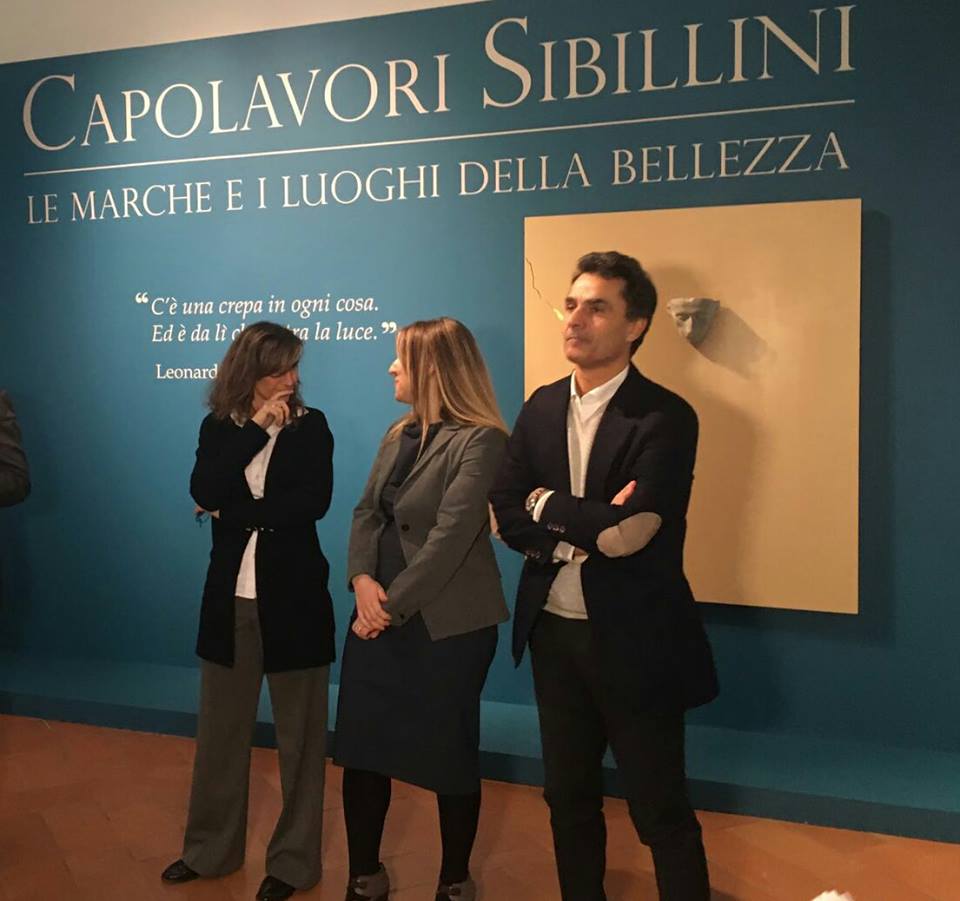
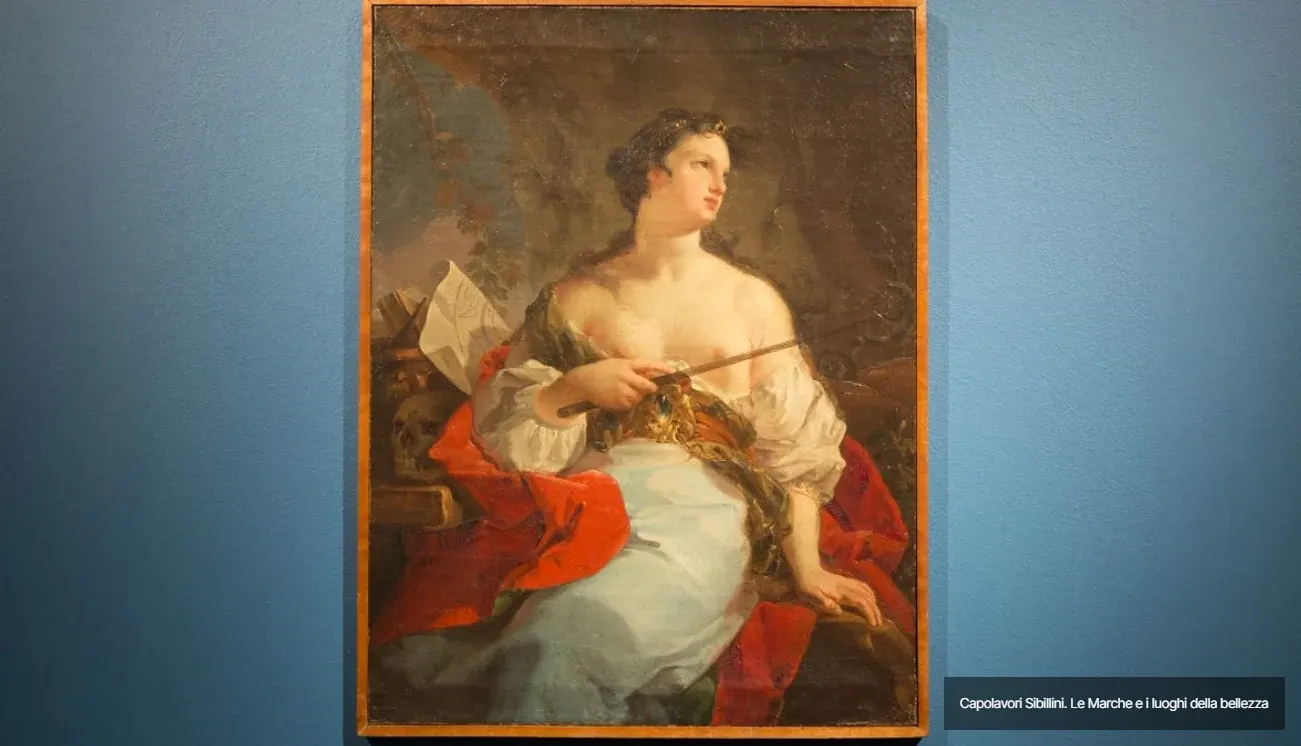
Yesterday, at a press conference for the Milanese public, museums from the Sibillini Museum Network presented the exhibition "Sibillini Masterpieces: The Marche and Places of Beauty." Curated by Daniela Tisi and Vittorio Sgarbi in collaboration with the "Carlo Maria Martini" Diocesan Museum of Milan, the exhibition features a prestigious selection of 56 artworks from areas of the Marche region struck by the 2016 earthquake.
Regional Councillor Moreno Pieroni in Milan for the exhibition's press conference.
The works are on display at the Diocesan Museum of Milan from today, December 21, through June 30, 2018, following their previous showing in Osimo (read the article). The exhibition showcases masterpieces by great masters such as Perugino, Crivelli, Spadino, Cristoforo Munari, Cristoforo Unterperger, Corrado Giaquinto, Simone De Magistris, Ignazio Stern, Nicola di Ulisse da Siena, Salvatore Monosilio, and Vincenzo Pagani—cultural treasures from a region where art and beauty must be preserved. "Today," said Moreno Pieroni, Regional Councillor for Tourism and Culture, at the press conference, "with this splendid initiative, we are giving concrete form to the 2018 tourism promotion plan. This plan focuses specifically on our region's culture and artistic heritage to promote the 'Marche' brand in an integrated way across Europe. It is also a unique way to send Christmas greetings to the Marche from Milan—from a national and international showcase that we are confident will help revitalize the areas affected by the earthquake and keep the spotlight on the immense cultural value they offer to visitors." This initiative is part of the 'Antenna Milano per l'Italia' program—an undertaking set to feature a wide range of activities throughout the year, designed to showcase the region's appeal and invite people to discover its beauty. The Region is investing heavily in promoting the cultural identity of the affected areas—and beyond—through diverse initiatives; the museum network itself, which encompasses the municipalities of the Sibillini mountains and inland areas, stands as a tangible and effective example of this effort.
"The Renaissance was not a sudden shutter raised to mark a 'before' and 'after,'" says Vittorio Sgarbi.
The three exhibitions he curated and organized across Fano, Pesaro, and Urbino—collectively titled "Rinascimento Segreto" (Secret Renaissance) and drawing 48,000 visitors—highlighted the significance of a cultural movement that was teeming with creative ferment and original solutions throughout Italy.
The Ducal Palace in Urbino, the Archaeological Museum and Pinacoteca of the Palazzo Malatestiano in Fano, and the Civic Museums of Palazzo Mosca in Pesaro showcased enduring Byzantine influences and echoes alongside flashes of insight—some strikingly modern—revealed through eighty works. Spanning the early 15th to the mid-16th century, this collection included paintings, sculptures, drawings, and sacred art objects that had previously remained "private" and unknown, never before exhibited in public museums because they belonged to banking foundations, institutions, or private collectors (including Sgarbi himself).
It was between 1470 and 1475 that painters' creativity reached its zenith, continuing to evolve in five-year cycles through the mid-16th century. These were the years of Mantegna, Cosmè Tura, Botticelli, Leonardo, Raphael, and Michelangelo, as well as Giovanni Bellini, Lorenzo Lotto, Titian, Correggio, and Parmigianino. Artists challenged one another and strove to surpass themselves, still fueled by the Humanism that had preceded the Renaissance. Yet alongside these giants stood many "minor" masters—extraordinary representatives of the Renaissance—hailing from the Tuscan, Umbrian, Venetian, Lombard, Emilian, and Romagnol schools.
To name just a few: Piero del Pollaiolo, Raphael, Perugino, Giulio Romano, Matteo Civitali, Agostino di Duccio, Desiderio da Settignano, Bonifacio de’ Pitati, Giovanni Bonconsiglio (known as Marescalco), Benvenuto Tisi (known as Garofalo), Dosso Dossi, Agostino da Lodi, Cesare Magni, Giovanni Francesco da Rimini, Bartolomeo Ramenghi (known as Bagnacavallo), Paolo da Visso, Giovan Francesco Penni, Liberale da Verona, and Cola dell’Amatrice. Among them are many natives of Ferrara (like Sgarbi himself, incidentally) and representatives of all the schools of the Italian Renaissance—from the Venetians to the Florentines, from Roman artists to those from the Marche region, including Raphael.
Let us be clear: art had been sublime even before those years. "But Piero della Francesca enriched it with an intelligence that transforms painting into thought—into a theorem—going far beyond mere devotional requirements," explains Sgarbi, pointing to the "leap" in religious iconography that the exhibition amply demonstrates, particularly in the section dedicated to Urbino.
The museums of the Sibillini Museum Network present “Capolavori Sibillini: Le Marche and the Places of Beauty” to the Milanese public; curated by Daniela Tisi and Vittorio Sgarbi, the exhibition is organized in collaboration with the Diocesan Museum. A prestigious selection of 56 artworks—originating from locations in the Marche region affected by the 2016 earthquake—will be on display at the Diocesan Museum in Milan from December 21, 2017, to June 30, 2018.
The exhibition features masterpieces by great masters such as Perugino, Crivelli, Spadino, Cristoforo Munari, Cristoforo Unterperger, Corrado Giaquinto, Simone De Magistris, Ignazio Stern, Nicola di Ulisse da Siena, Salvatore Monosilio, and Vincenzo Pagani—representing the cultural riches of a territory where art and beauty must be preserved.
Established in 2013, the Sibillini Museum Network currently comprises ten municipalities: Montefortino, Montefalcone Appennino, Smerillo, Monte Rinaldo, Montelparo, Montalto delle Marche, Loro Piceno, San Ginesio, Sarnano, and Ripe San Ginesio. The network covers an area spanning three provinces—Ascoli Piceno, Fermo, and Macerata—and encompasses the Sibillini Mountains National Park. Its goal is to communicate and promote the region's cultural heritage across historical, cultural, artistic, environmental, and productive dimensions.
Part of a broader project to showcase the cultural heritage of the Marche region, this exhibition aims to bring the general public closer to the artistic treasures of the Sibillini Museum Network. Indeed, some of the works come from the previous exhibition—which concluded on November 19 in Osimo—titled “Sibylline Masterpieces: Art from Places Scarred by the Earthquake.” This was an initiative of great cultural and civic significance, attended by Minister Franceschini, recognized by the highest state authorities, and honored with a medal from the President of the Italian Republic, Sergio Mattarella.